Three months after going live, Emma called a quarterly business review meeting. The energy in the conference room was cautiously optimistic—not celebratory, but quietly hopeful. The team gathered as Emma pulled up the financial dashboard.
“Let me start with the most important number,” Emma said, highlighting the EBITDA line. “This quarter: essentially break-even. We’ve achieved what Klaus calls a ‘black zero’—not profitable yet but no longer losing money.”
She displayed the progression:
- Q2 (pre-implementation): -€156,000 EBITDA
- Q3 (during implementation): -€89,000 EBITDA
- Q4 (first full quarter live): +€3,000 EBITDA
“We’ve turned around a negative trend and stabilised the business,” Emma continued. “That’s significant, but it’s early. Three months isn’t – by far – long enough to see the full financial impact. Most of our gains are still procedural rather than financial. However, I wanted to check early if we are on track or not.”

Klaus pulled up the operational metrics. “Let me show you what we can actually measure after three months.”
The Modest Gains
Klaus displayed a conservative dashboard:
On-Time Delivery Performance:
- Before: 72%
- After three months: 77%
- Improvement: +5 percentage points
“We’re trending in the right direction,” Klaus explained, “but three months isn’t enough to fundamentally change customer perception. Some of these orders were already late when we went live. We’re preventing new delays, but we’re still working through the backlog of trust issues with customers.”
Overtime Hours:
- Before: 127 hours/week average
- After three months: 108 hours/week average
- Improvement: -15%
“Better, but not dramatic,” Klaus noted. “We’ve eliminated some emergency overtime, but we’re still learning to plan capacity effectively. Some weeks, we still scramble.”
Schedule Adherence:
- Week 1: 67% (schedules followed as published)
- Week 4: 73%
- Week 12: 76%
- Improvement: Positive trend, not yet stable
“This metric matters most,” Klaus emphasised. “It shows whether we’re actually following the processes we designed. 76% means we’re following the schedule about three days out of four. Better than before, but we have room for improvement.”
Throughput:
- Before: 68 production orders/week
- After three months: 71 production orders/week
- Improvement: +4%
“Modest throughput increase,” Klaus admitted. “We expected more, but we’re still learning the system. As we get better at scheduling, throughput should improve further.”
Emma studied the numbers. “I like that all KPIs indicate in the right direction. However, these aren’t the dramatic gains we hoped for.”
“No,” Klaus agreed. “But they’re real gains with a solid foundation. We’ve stabilised the business. Now we need to maintain discipline to build on that foundation. Operational discipline—the consistent execution of well-designed processes—determines whether scheduling software implementations succeed long-term or gradually deteriorate back to chaos”
The Process Adherence Reality
Sarah pulled up her process tracking dashboard—something she’d started maintaining after Henning’s go-live warning about discipline.
“The financial gains are modest because of two reasons: First, we need to be patient and trust in the long run. Second, our process adherence is inconsistent,” Sarah said bluntly. “We designed routines, but we’re not following them as consistently as we should.”
She displayed the adherence metrics:
Daily Scheduling Routine Adherence:
- 8 AM final schedule publication: 66% (missed almost 2 days/week average)
- Morning production meeting held: 91%
- Schedule change communications sent: 78%
Weekly Routine Adherence:
- Weekly horizon review completed: 58% (missed 5 weeks out of 12)
- Critical materials list reviewed: 67%
- Operator skill matrix updated: 71%
Monthly Routine Adherence:
- Data quality review completed: 100% (3/3 months)
- Process refinement meeting: 67% (2/3 months)
- Configuration tuning: 33% (1/3 months)
“These numbers show the second reason why our gains are modest,” Sarah explained. “We’re following the critical daily routines with less discipline than we should. And we’re skipping weekly and monthly routines that prevent problems before they become crises.”
Otto nodded grimly. “And when we skip routines, we pay for it later.”
Example One: The Skipped Horizon Review
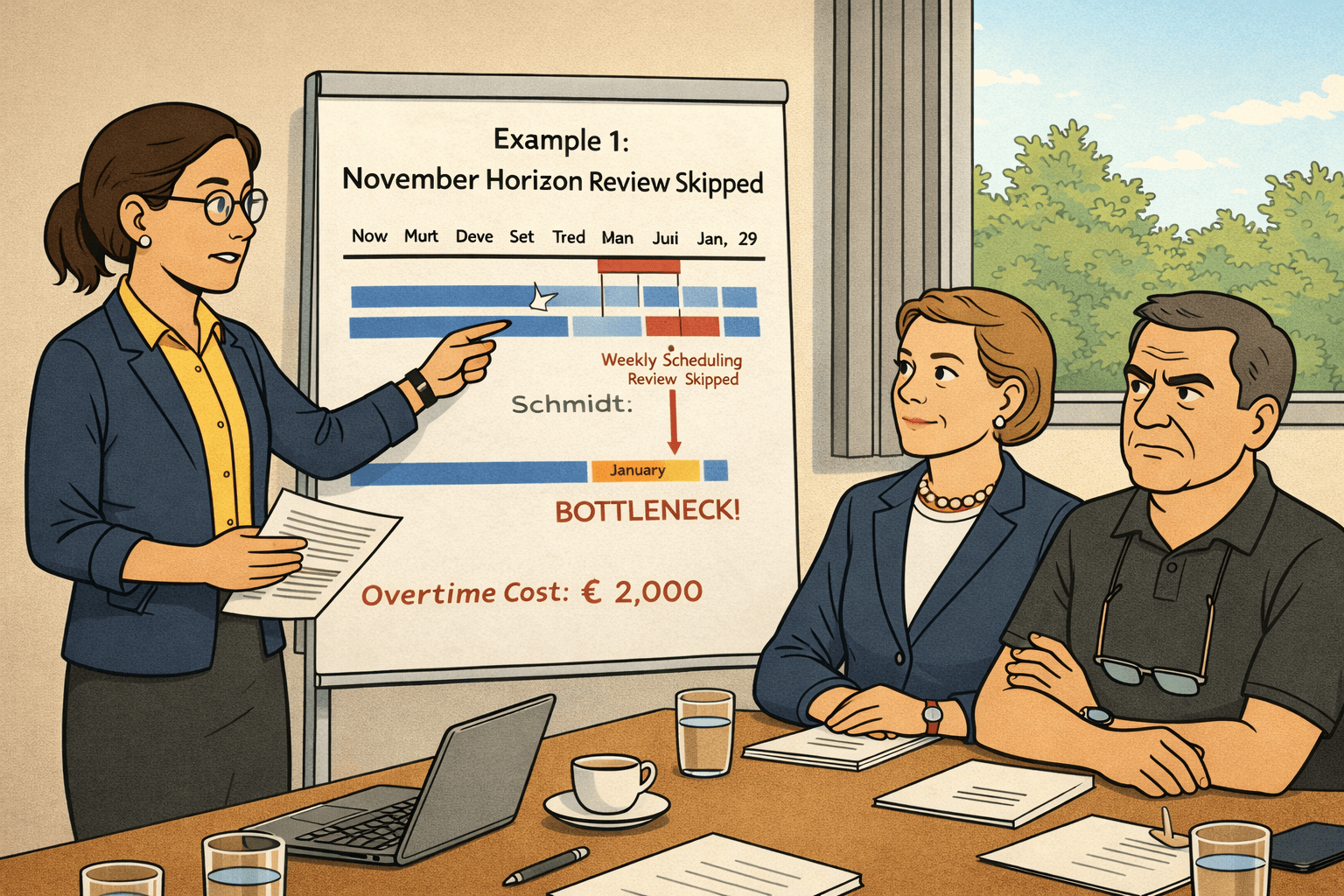
Sarah pulled up a specific example from a few weeks ago. “This is what happens when we skip weekly horizon reviews.”
She displayed the scheduling horizon from early November. “We were busy with daily crises, so we skipped our weekly review for two consecutive weeks. That review is supposed to look three months ahead and flag capacity hotspots.”
“What did we miss?” Emma asked.
“We missed a bottleneck building in January,” Sarah replied. “Multiple bearing housing orders: all scheduled for the second week of January, all requiring Schmidt. By the time we noticed in mid-December, it was too late to cross-train anyone or reschedule orders without impacting deliveries.”
She showed the result. “We ended up working 22 hours of overtime that week—exactly the emergency scrambling we were trying to eliminate. If we’d done the weekly horizon review in November, we would have seen it coming and prevented it.”
“Cost of skipping the routine?” Klaus asked.
“Direct overtime cost: €1,280,” Sarah replied. “Indirect cost of schedule disruption, rush coordination, and stress: probably another €800-1,000. Total impact of skipping a one-hour review meeting: roughly €2,000.”
Patrick added technical context. “And the missed review created a trust issue. When we suddenly told customers in December that January deliveries were at risk, they questioned our scheduling reliability. We’d been building trust, and one failure set us back.”
Example Two: The Manual Override Cascade
Otto stood to share the second example. “This one’s on me. I made a manual override without following the protocol.”
He displayed the incident. “Wednesday morning, Mazak #3 started making noise. I moved a job from #3 to #4 to protect the machine. That’s fine—that’s exactly when I should make such immediate changes.”
“But?” Emma prompted.
“But I forgot to lock the change and notify Sarah,” Otto admitted. “So, when Sarah ran the afternoon schedule regeneration, the software moved the job back to #3. I didn’t notice until Thursday morning when the operator showed up, and the job wasn’t where I’d assigned it.”
“What happened?” Emma asked.
“Chaos,” Otto replied bluntly. “The operator wasted thirty minutes looking for his job assignment. We had to scramble to set up #4 instead of #3, which took longer because the tooling wasn’t ready. The job that was supposed to finish on Thursday afternoon didn’t complete until Friday morning. That delayed the next operation, which pushed a customer delivery from Friday to Monday.”
Sarah pulled up the cascade analysis. “One missed protocol step—Otto not locking his manual change—created a two-day delay on a customer order. The customer was understanding, but we damaged the credibility we’d been building.”
“Cost?” Klaus asked.
“Lost productivity from the confusion: maybe €300,” Sarah calculated. “Customer relationship damage: hard to quantify but real. And reinforcement of the old pattern—chaos breeding more chaos.”
Example Three: The Communication Gap
Klaus shared the third example. “We also had a material delay that affected four production orders. Sarah rescheduled them appropriately, updated the system, but the schedule change report that’s supposed to go to me at 9 AM daily didn’t generate because of a system glitch Patrick was troubleshooting.”
“I should have checked manually,” Klaus admitted, “but I’d gotten into the routine of just reading the automated report. So, I didn’t know about the schedule changes. When customers called asking about their orders, I confirmed the original dates because I didn’t know they’d slipped.”
Sarah winced. “Then I called the customers that afternoon to proactively communicate the delays, only to discover Klaus had already confirmed the old dates that morning. We looked incompetent—one person saying one thing, another person saying something different four hours later.”
“Impact?” Emma asked.
“Two customers escalated complaints to management level,” Klaus reported. “We recovered by apologizing and explaining our process breakdown, but it was embarrassing and avoidable.”
Patrick added, “The system glitch was my fault—I was updating the reporting configuration and didn’t test thoroughly. But the larger failure was that we didn’t have a backup process. We’d designed a routine that depended on automation, and when automation failed, we had no fallback.”
The Discipline Discussion
Emma let the three examples sink in before speaking. “What I’m hearing is we need to improve our process discipline. When we follow the routines we designed, things work. When we skip routines or cut corners, we create problems that cost us money and credibility.”
“Exactly,” Sarah confirmed. “The software works fine. The processes we designed are sound. But we’re not executing them consistently enough to get the full benefit.”
“Why not?” Emma asked. “What’s preventing consistent execution?”
Otto answered first. “Sometimes it’s just busyness. The weekly horizon review gets pushed because we’re dealing with today’s crisis. We tell ourselves we’ll do it tomorrow, then tomorrow never comes.”
“Sometimes it’s complacency,” Klaus admitted. “Things are going okay, so we think we can skip a routine without consequences. Then we discover the routine was preventing problems we didn’t see.”
“And sometimes it’s just forgetting,” Sarah said. “I’m supposed to check that Klaus received the schedule change report. Some days I remember, some days I don’t. When I don’t, we get failures like just discussed.”
Patrick offered a technical observation. “We built the system assuming perfect execution. We didn’t build in reminders, checks, or alerts for when routines are skipped. The software tracks whether the scheduler ran, but it doesn’t track whether Sarah completed her review or Klaus sent his communications.”
“So we need both cultural discipline and technical support for that discipline,” Emma concluded.
Building Operational Discipline: The Path Forward
Emma stood and walked to the whiteboard—not the old scheduling whiteboard, which now hung as a memorial, but a blank whiteboard for strategic discussion.
“Here’s what I want for the next quarter. Not dramatic financial gains, but disciplined process execution.”
She wrote three objectives:
- Process Adherence Improvement
- Daily routines: 95% adherence
- Weekly routines: 90% adherence
- Monthly routines: 100% adherence
- Technical Support for Discipline
- Build alerts when routines are skipped
- Create checklists for complex processes
- Automate tracking of adherence metrics
- Learn from Failures
- Document every process breakdown
- Analyze root causes
- Implement preventive measures
“These aren’t exciting objectives,” Emma acknowledged. “They’re boring. But Henning was right—boring discipline is what creates sustainable success. We’ve built good processes. Now we need to execute them consistently.”
Sarah pulled up her calendar. “I’m going to schedule all the routines as recurring appointments with alerts. Weekly horizon review: every Friday at 10 AM, non-negotiable. Skill matrix update: every Monday morning as part of the production meeting. Schedule change report verification: daily at 9:15 AM, fifteen minutes after Klaus should receive it.”
“I’ll build process adherence dashboards,” Patrick offered. “If we’re supposed to publish the final schedule at 8 AM and we miss it, the dashboard turns red. If we skip two weekly horizon reviews in a row, it sends an alert to Emma. Make the discipline visible.”
Otto looked thoughtful. “Can we also build feedback loops? Like, after we skip a routine and something goes wrong, can we calculate what that failure costs? Nothing motivates discipline like seeing the price of skipping routines.”
“I like that,” Klaus said. “The horizon review failure cost us €2,000. My communication failure cost us customer trust and nearly cost us order volume. Make those costs visible so we remember why the routines matter.”
The Cultural Shift
As the meeting wound down, Emma returned to the financial numbers displayed on the screen.
“We achieved break-even this quarter. That’s significant—it means we’ve stopped the bleeding. But, of course, it is not yet the victory we are aiming for in the long term.”
She paused, looking around the table. “However, I want you to understand something. The break-even result on a three-month horizon is actually appropriate. Real operational transformation takes time. We’ve spent three months learning the system, building new habits, and discovering where our processes need refinement.”
“The financial gains will come,” Emma continued, “but only if we maintain discipline. The next quarter, I want to see two things: continued financial stability and dramatically improved process adherence. If we achieve 95% daily routine adherence and 90% weekly routine adherence, the financial results will follow naturally.”
Sarah felt the weight of this expectation, but also the clarity. They weren’t failing—they were learning. The modest gains weren’t disappointing—they were appropriate for where they were on the journey.
“One more thing,” Emma added. “I know it’s tempting to compare ourselves to the dramatic success stories Stefan showed us during software evaluation—companies that achieved 30% throughput gains in three months. Those stories are real, but they’re also carefully selected highlights and usually refer to a longer observation period. Most companies experience what we’re experiencing in the early stages: modest early gains, process refinement, gradual improvement.”
“We’re not failing because our gains are modest,” Emma emphasized. “We’re succeeding because we’re being honest about our challenges and working systematically to address them. That’s more valuable than dramatic short-term gains that aren’t sustainable.”
The Evening Conversation
That evening, Sarah arrived home looking thoughtful rather than stressed. Miguel noticed immediately.
“How was the review?” he asked.
“Sobering,” Sarah replied. “To be honest, we’re not transforming as fast as I hoped. The financial gains are o.k. but not enough yet—basically break-even. And our process discipline is inconsistent.”
“Are you discouraged?” Miguel asked.
“No,” Sarah said, surprising herself. “Actually, I feel clearer than I have in weeks. We know exactly what’s not working—we’re skipping the routines we designed. And we know how to fix it—execute the routines more consistently.”
Tom looked up from his homework. “Is that like when my coach says we’re not following the game plan?”
“Exactly like that,” Sarah confirmed. “We have a good game plan—the scheduling processes we designed. But we’re not following it consistently. Some days we follow it perfectly, some days we improvise. And when we improvise, we lose.”
“What does Coach say about following the game plan?” Miguel asked Tom.
“He says trust the system, execute the fundamentals, and results follow,” Tom recited.
Sarah smiled. “That’s exactly what Emma said today. Trust the processes we designed, execute them consistently, and the financial results will follow. But we can’t skip fundamentals and expect results.”
Miguel pulled up his own calendar. “Want to put your work routines in our family calendar? That way I can see when you have critical work commitments and not schedule family things that conflict.”
“That would help,” Sarah said. “Friday 10 AM is weekly horizon review—I can’t miss those anymore. Monday morning production meeting. Daily 8 AM schedule publication. If those are in our shared calendar, we can plan around them.”

“Are you okay with that level of routine?” Miguel asked. “It sounds very structured.”
Sarah thought about it. “Three months ago, I would have resented that structure. I wanted flexibility and spontaneity. But now I realize—structure in work routines creates flexibility in life. When I follow the 8 AM publication routine, I can leave work at 5 PM confidently. When I skip routines and scramble later, I work late and miss dinner.”
“So discipline creates freedom,” Miguel observed.
“Boring discipline creates sustainable freedom,” Sarah corrected. “That’s the lesson from today. The dramatic transformation we were hoping for comes from boring, consistent execution of good processes.”
Tom had returned to his homework, but he looked up one more time. “Mom, are you going to be home for my game on Saturday?”
“Absolutely,” Sarah replied. “Already on my calendar, non-negotiable.”
“Even if there’s a work emergency?” Tom pressed.
Sarah paused. Three months ago, she would have said “probably” or “I’ll try.” Now she said something different.
“The work emergencies are decreasing because we’re getting better at preventing problems. And the routines we’re building—the ones I’m committing to follow more consistently—those prevent emergencies before they happen. So yes, I’ll be at your game. Not because I’m hoping there won’t be an emergency, but because we’re building systems that prevent emergencies.”
Tom nodded, satisfied, and returned to his homework.
Miguel squeezed Sarah’s hand. “Three months beyond the whiteboard. Not transformed yet, but transforming.”
“Exactly,” Sarah agreed. “And that’s actually more sustainable than instant transformation would be. We’re building habits, not just implementing software. And habits take time.”
She looked at her process adherence dashboard on her laptop—84% daily adherence, 58% weekly adherence. Not great, but measurable. Improvable.
Next quarter, those numbers would be better. Not because they’d work harder, but because they’d work more consistently. Following the routines they’d designed, executing the processes they’d built, maintaining the discipline that Henning had warned was the real work.
Beyond the whiteboard wasn’t a destination they’d reached. It was a journey they were on—three months in, with improvement visible but not yet complete.
That was okay. Actually, it was exactly right.