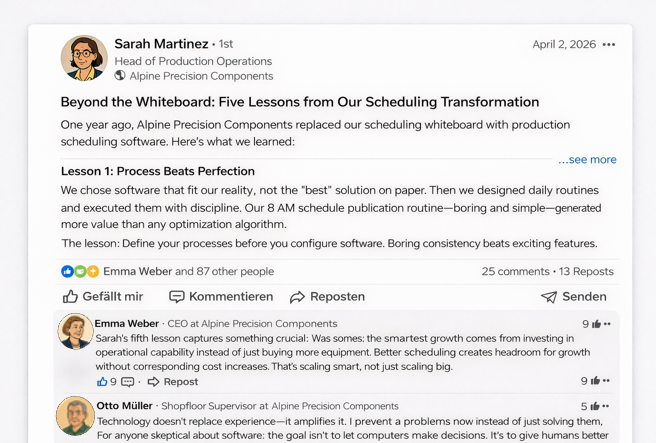

Twelve months after going live, Emma called an annual review meeting that felt distinctly different from the three-month checkpoint nine months earlier. The conference room had the energy of quiet confidence—not celebration, but solid satisfaction.
Emma pulled up the annual financial dashboard, and this time the numbers told a compelling story.
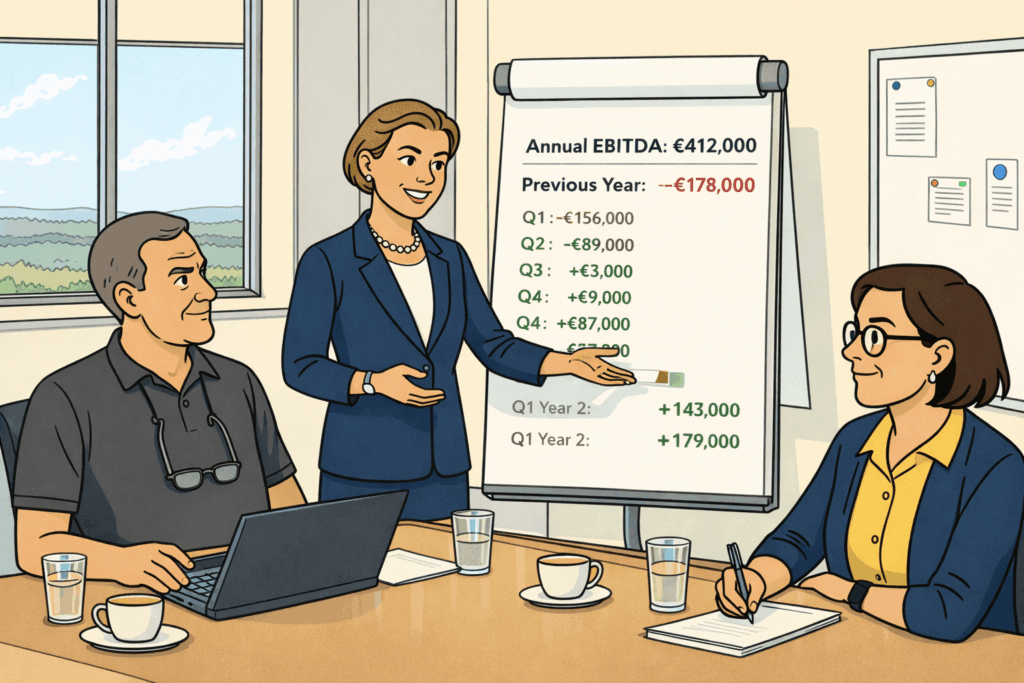
“Let me start with the result that matters most,” Emma said. “This year: EBITDA of €412,000. That compares to the previous year’s negative €178,000.”
She displayed the quarterly progression:
- Q1 (pre-implementation): -€156,000
- Q2 (implementation): -€89,000
- Q3 (first quarter live): +€3,000
- Q4 (discipline building): +€87,000
- Q1 Year 2: +€143,000
- Q2 Year 2: +€179,000
“You can see the curve,” Emma noted. “Slow improvement initially, then accelerating gains as we mastered the processes. The last two quarters have been our strongest in five years. It seems that we have achieved manufacturing operational excellence.”
Klaus pulled up the operational metrics that had matured over twelve months.
The Sustained Improvements
Klaus displayed the twelve-month operational transformation:
On-Time Delivery Performance:
- Before: 72%
- After twelve months: 94%
- Improvement: +22 percentage points
“This took time to achieve,” Klaus explained. “At three months, we were at 77%. At six months, we hit 87%. At nine months, we reached 92%. In the last quarter, we’ve sustained 94%. Customers notice and trust us now.”
Overtime Hours:
- Before: 127 hours/week average
- After twelve months: 82 hours/week average
- Improvement: -35%
“The overtime reduction accelerated once we maintained consistent process discipline,” Klaus noted. “We still work overtime, but it’s planned capacity management, not emergency firefighting.”
Throughput:
- Before: 68 production orders/week
- After twelve months: 81 production orders/week
- Improvement: +19%
“This gain came gradually,” Klaus emphasized. “We’re producing 19% more with the same equipment and similar headcount because we’ve eliminated chaos, increased the skill sets of our operators, improved capacity utilization, and prevented bottlenecks systematically.”
Customer Complaints:
- Before: 4.3/month delivery-related
- After twelve months: 0.6/month
- Improvement: -86%
“And those remaining complaints are typically outside our control,” Klaus added. “We’ve essentially eliminated complaints about our own scheduling and delivery.”
Emma let the numbers speak for themselves before asking the critical question: “What changed between the modest three-month results and these twelve-month results?”
The Discipline Journey
Sarah stood to answer, pulling up her process adherence tracking—now a mature dashboard that she’d maintained religiously for twelve months.
“Process discipline,” Sarah said simply. “At three months, we were following daily routines 66% of the time and weekly routines 58% of the time. Today we’re at 97% daily adherence and 94% weekly adherence.”
She displayed the twelve-month adherence curve:
Daily Scheduling Routine Adherence:
- Month 3: 66%
- Month 6: 82%
- Month 9: 91%
- Month 12: 97%
Weekly Routine Adherence:
- Month 3: 58%
- Month 6: 78%
- Month 9: 88%
- Month 12: 94%
Monthly Routine Adherence:
- Month 3: 67%
- Month 6: 100%
- Month 9: 100%
- Month 12: 100%
“The financial gains correlate directly with process adherence,” Sarah explained. “When we skip routines, we create problems that cost money and damage credibility. When we execute routines consistently, we prevent problems and compound our gains.”
Otto added his perspective. “The first three months, following routines felt like work—extra work on top of our real work. Now the routines are our real work. We don’t think about whether to do the 8 AM schedule publication or the weekly horizon review. We just do them, like breathing.”
“It became a habit,” Patrick confirmed. “And once it became a habit, it stopped requiring conscious effort. The discipline became automatic. Manufacturing operational excellence isn’t achieved through software implementation—it’s achieved when disciplined processes become organizational habits that no longer require conscious effort to maintain.”
The Culture Transformation: Achieving Manufacturing Operational Excellence
Emma pulled up photos from morning production meetings across the year.
The three-month photo showed the team reviewing the large display screen, still somewhat tentative, still learning.
The twelve-month photo showed something different—the team engaged, confident, collaborative. They weren’t learning the system anymore. They were using it naturally.
“The cultural shift is the most significant change,” Emma observed. “Sarah, describe what’s different in how we operate now.”
Sarah thought about how to articulate the transformation. “A year ago, even with the software, we were still thinking reactively. We’d use the software to respond to problems faster, but we were still responding. Now we think proactively. We prevent problems before they occur.”
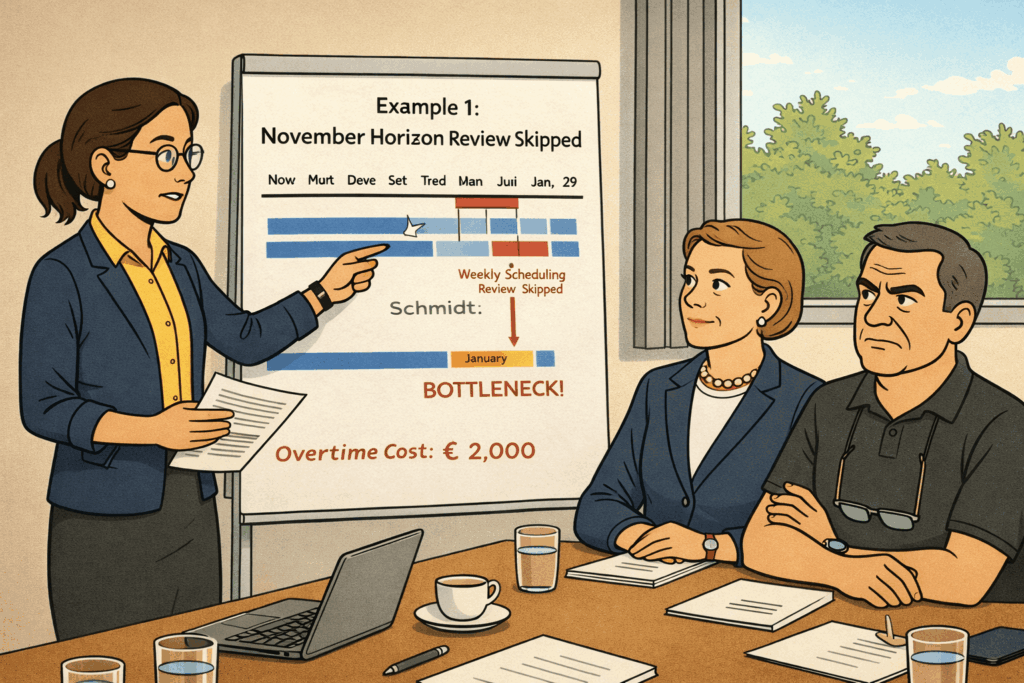
She pulled up this morning’s production meeting notes as an example. “This morning, we discussed next week’s schedule. We identified a potential bottleneck on Thursday—two jobs competing for Schmidt. But instead of waiting until Thursday to scramble, we’ve already solved it. Weber completed training last month to back up Schmidt on one of those job types. We scheduled Weber for one job, Schmidt for the other. Problem prevented, not solved.”
“And that prevention thinking is everywhere now,” Otto added. “Yesterday, I noticed a machine making subtle vibration changes. Six months ago, I’d have run it until it broke, then scrambled to recover. Yesterday, I scheduled maintenance for next Tuesday during a natural capacity gap. The maintenance will prevent a breakdown that would have cost us three days of capacity.”
Klaus contributed a sales perspective. “Customer conversations have changed fundamentally. A year ago, customers would ask for delivery dates, and I’d give optimistic estimates based on hope. They’d learned not to trust those dates. Now I run a what-if scenario in the scheduler, get a capacity-based date, and tell them confidently. And because we hit those dates 94% of the time, they trust us. We’re winning business specifically because of delivery reliability.”
The Ripple Effects
Emma moved to discuss the broader organizational impacts that had emerged over twelve months.
“The scheduling transformation rippled through the entire company,” Emma said. “Klaus, talk about the sales impact.”
Klaus pulled up his pipeline analysis. “Win rate on new quotes increased from 35% to 52%. Customers choose us over competitors specifically for delivery reliability. We’ve also seen order volume from existing customers increase—Brenner grew their business with us by 28% this year because they trust our delivery commitments.”
“They also designated us a preferred supplier in month eight,” Klaus added. “That brought a 25% volume commitment increase and better pricing on the work they give us. That relationship upgrade happened because of twelve months of consistent delivery performance.”
Patrick discussed the technical ripple effects. “The integration between Business Central MRP and the scheduler has matured significantly. Purchase material requirements are now based on capacity-constrained schedules, so we’re buying what we need when we actually need it. Inventory of purchased materials decreased by 18%, while stockout incidents decreased by 31%. We’re leaner and more reliable simultaneously.”
Otto contributed from operations. “Quality control transformed their approach. They can predict when jobs will need inspection based on the schedule, so they staff appropriately. Their utilization improved, their overtime decreased, and their defect detection improved because they’re not rushed. Preventive maintenance became possible because we can schedule it during capacity gaps. Equipment reliability improved 23% this year.”
“The transformation extended beyond production,” Emma summarized. “Better scheduling enabled better sales, better purchasing, better quality, better maintenance. It became an integrated operational improvement, not just a scheduling upgrade.”
Sarah’s Evolution
Emma looked at Sarah directly. “You’ve changed significantly over this year. Talk about that.”
Sarah felt slightly self-conscious but answered honestly. “A year ago, I was a reactive scheduler—solving daily problems, moving jobs around, reacting to crises. Today I’m thinking strategically about operations—capacity planning, process improvement, organizational capability building.”
She pulled up examples. “Last month, I presented our scheduling transformation at the regional SMB manufacturing conference. Seventy people attended—other companies facing the same challenges we faced a year ago. I could speak from experience about what works, what doesn’t, and why process discipline matters more than software features.”
“Three companies have contacted me since that presentation asking for advice on their scheduling projects,” Sarah continued. “I’ve become a mentor to others going through what we went through. That shift—from struggling myself to helping others—that represents growth I didn’t expect.”
Klaus added, “Sarah’s role has expanded beyond scheduling. She thinks about our entire production flow now—capacity strategy, bottleneck management, and continuous improvement initiatives. Emma formalized it by promoting her to Head of Production Operations, but Sarah was already operating at that level.”
Emma nodded. “The promotion recognized reality. And Sarah’s maintained work-life balance while expanding her role—she leaves at 5 PM most days, makes Tom’s football games, and has dinner with her family. The expansion isn’t about working more hours. It’s about working more strategically.”
The Team’s Growth
Emma looked around the table at the entire team. “Everyone has grown. Otto, you were the most skeptical about software replacing the whiteboard. Now you’re the strongest advocate for systematic operation.”
Otto smiled slightly. “I learned that the software doesn’t replace experience; it amplifies experience. My thirty years of shop floor knowledge is more valuable now because I can apply it proactively across three days instead of reactively in three hours.”
“And you’re training others,” Emma noted. “You’ve cross-trained three operators this year specifically to reduce bottleneck dependencies. That’s strategic thinking.”
She turned to Patrick. “You’ve evolved from maintaining systems to designing integrated solutions. The process adherence dashboards, the automated alerts when routines are skipped, and the quality metrics tracking—those weren’t in the original software. You built them because you saw what we needed.”
Patrick nodded. “I stopped thinking about IT as a separate function and started thinking about it as operational enablement. The question isn’t ‘how do I maintain this system?’ but ‘how can technology support better operations?'”
Emma looked at Klaus. “And you’ve transformed from questioning every software investment to using data systematically for business decisions. Your capacity planning analysis last quarter—projecting where we’ll need additional resources over the next two years—that was sophisticated strategic thinking.”
“I learned to trust the data,” Klaus admitted. “A year ago, I trusted my gut and spreadsheet calculations. Now I trust systematic analysis based on real operational data. It’s more reliable.”
Continuous Improvement
Emma moved to the future-looking part of the review. “We’ve achieved significant gains, but we’re not done improving. What’s next?”
Otto spoke up immediately. “We need to move beyond the whiteboard in another way—beyond paper-based shop floor tracking.”
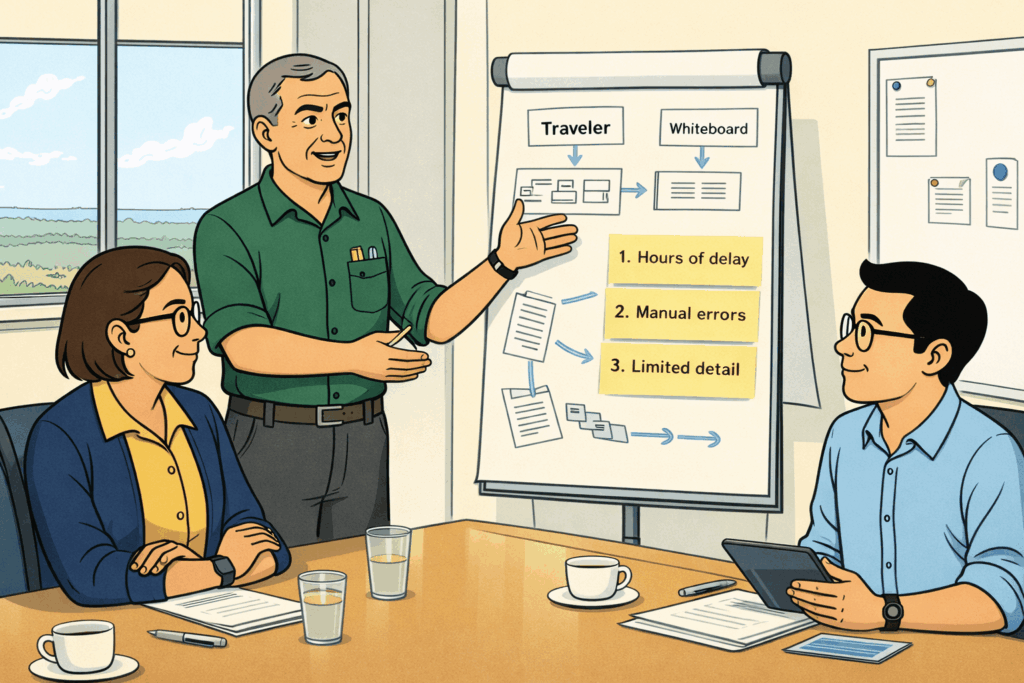
He explained: “Right now, when an operation finishes, the operator fills out a paper traveler and puts it in a bin. Someone collects those travelers at the end of the shift and enters the data into Business Central. That process has three problems.”
“First, latency,” Otto continued. “We don’t know an operation is finished until hours later when someone enters the data. Second, errors—manual data entry creates mistakes. Third, limited detail—we capture that the operation finished, but we don’t capture when it started, how long setup took, or why it might have taken longer than planned.”
Sarah was nodding. “This connects to the communication protocol we designed. When Otto needs to tell me about a deviation, he calls or sends a message. It works, but it’s manual and depends on Otto remembering to communicate. What if the system knew automatically when operations finished and could alert me to deviations?”
Patrick pulled up a technical diagram he’d been working on. “I’ve been researching digital shop floor data collection. Operators could report operation completions on tablets at their workstations. The data flows immediately to Business Central and the scheduler. We’d have real-time visibility instead of end-of-shift visibility.”
“And we could capture richer data,” Sarah added. “Actual start times, actual finish times, actual setup duration. Over time, that data would improve our routing accuracy because we’d be comparing planned times to actual times systematically.”
Klaus saw the business case immediately. “This would also enable the performance metrics we couldn’t implement at launch. We could track schedule adherence at the operation level, not just the order level. We could measure operator productivity, identify bottlenecks more precisely, and optimize based on real data instead of estimates.”
Emma listened carefully. “This sounds like our next major project. What would it take?”
Patrick outlined the scope. “Tablets at each workstation—probably twelve devices total. Software for shop floor data collection that integrates with Business Central and our scheduler. Training for operators in the new reporting process. Probably three to four months of implementation, similar to what we did with scheduling.”
“And cost?” Emma asked.
“In the first year, approximately €15,000 to €25,000. This includes the one-time investment for the hardware and the annual subscription fees for the software. I assume, that the latter range between €6,000 and €12,000, ” Patrick estimated. “Plus internal time for configuration and training. Total investment is somewhat comparable to the scheduling project.”
Emma looked thoughtful. “A year ago, I would have questioned whether we should make another technology investment so soon. Now I understand—this isn’t separate from the scheduling project. It’s the next phase of the same operational transformation.”
“Exactly,” Sarah confirmed. “We moved beyond the whiteboard for scheduling. Now we need to move beyond paper for shop floor tracking. It’s the same journey—replacing manual, reactive processes with systematic, proactive processes.”
Otto added, “And the timing is right. We’ve mastered the scheduling routines. We’ve built the discipline to execute processes consistently. We’re ready to add another layer of systematic operation.”
The Investment Decision
Emma stood and walked to the window overlooking the shop floor—just as she had a year earlier when they were discussing the scheduling software investment.
“Let me share what I’ve learned this year,” Emma said. “The scheduling software investment wasn’t really about software. It was about building organizational capability—the processes, disciplines, and systematic thinking that enable operational excellence.”
She turned to face the team. “That capability is more valuable than any single technology. The software will be outdated in five to ten years. But the discipline to design processes, execute them consistently, and improve them continuously—that capability will serve Alpine for decades.”
“So, when we talk about investing in shop floor data collection,” Emma continued, “we’re not talking about buying tablets and software. We’re talking about building the next layer of operational capability. And based on what we’ve learned this year, I’m confident we can do that successfully.”
She looked at Patrick. “Start detailed planning. I want a project proposal by the end of next month—scope, timeline, costs, expected benefits, implementation approach. We’ll review it and decide whether to proceed. Also, I want you to involve Henning in that process again.”
Patrick nodded, already making notes.
“But I have one non-negotiable requirement,” Emma added. “We don’t start shop floor tracking until we’ve maintained 95% adherence to our scheduling routines for three consecutive months. We’ve achieved that now, but if adherence slips, we pause the new project. We don’t layer new complexity on top of failing discipline.”
“Agreed,” Sarah said immediately. “Process discipline is the foundation. Everything else builds on that foundation.”
The Customer Testimony
As the meeting was concluding, Klaus pulled up an email that had arrived while they were discussing the shopfloor data collection project.
“I want to share something,” Klaus said. “This is from Brenner Industries’ VP of Operations.”
He read aloud: “Dear Emma and the Alpine team: We’ve worked with Alpine for eight years, and this past year has been transformational. Your delivery reliability has been flawless on several hundred orders. More importantly, your communication has been proactive and honest. When occasional delays occur, you alert us immediately with realistic recovery plans. You’ve evolved from a capable supplier to an indispensable strategic partner. We’re increasing our annual commitment by an additional 15% and would like to discuss co-development opportunities for new product lines. Your operational excellence gives us confidence to invest in our partnership.”
The room was quiet for a moment.
“That email represents the business impact of our transformation,” Emma said. “Not just the financial metrics, not just the operational improvements, but the customer relationships and growth opportunities those improvements enable.”
She displayed the year’s revenue growth: 12% overall, with Brenner’s business growing 43%.
“Operational excellence creates competitive advantage,” Emma concluded. “We’re winning business and growing relationships because we deliver what we promise. That’s the real return on our scheduling transformation—not just efficiency, but capability that drives growth.”
The Celebration
That evening, the team gathered for a small celebration at a restaurant near the office. Emma had invited everyone who’d been part of the transformation—Sarah, Klaus, Otto, Patrick, the supervisors who’d embraced the new processes, even Stefan, who’d guided the implementation and stayed connected throughout the year.
Miguel joined Sarah at the celebration, bringing Tom, who’d asked to come because “I want to see what Mom’s been working on for a year.”
Emma stood to offer a toast. “One year ago, we went live with scheduling software. We hoped for a dramatic transformation and got modest improvement initially. We learned that transformation doesn’t come from software and that it doesn’t come overnight—it comes from discipline, process, and continuous improvement.”
She raised her glass. “Today, one year later, we see the results of that discipline. We’re operationally excellent, financially strong, and positioned for growth. We’ve built a capability that will serve Alpine for years. To the team that made this happen through boring, consistent execution of good processes.”
“To boring discipline,” Klaus added with a smile.
“To preventing problems instead of solving them,” Otto contributed.
“To process over software,” Sarah finished.
They toasted, and the celebration continued with stories from the year—the early struggles, the process failures that taught them discipline, the gradual improvement that compounded into transformation.
Later, Tom pulled Sarah aside. “Mom, can I ask you something?”
“Of course,” Sarah replied.
“A year ago, you were really stressed about work. You missed games and dinners. You were always on your phone. Now you’re not stressed, and you’re home for dinner every night. What changed?”
Sarah thought about how to explain it to a ten-year-old.
“A year ago, I was fighting fires—reacting to problems as they happened,” Sarah explained. “Now we prevent fires before they start. Same work, but different approach. Prevention is less stressful than constant emergency response.”

“Like how Coach makes us practice basics, so we don’t make mistakes in games?” Tom asked.
Sarah smiled. “Exactly like that. We practiced the basics of good scheduling processes until they became automatic. Now we don’t make the mistakes that used to create stress.”
Tom nodded, satisfied. “That makes sense. I like that you’re home more.”
“Me too,” Sarah said, hugging him.
Miguel joined them. “One year beyond the whiteboard. Was it worth it?”
Sarah looked around the celebration—the team laughing, the confidence in the room, the growth she’d experienced personally and professionally.
“Absolutely,” Sarah replied. “Not because the software was magic, but because it forced us to become more systematic, more disciplined, more professional in how we operate. The transformation was organizational, not technological.”
“And the next transformation?” Miguel asked, referencing the shop floor tracking project Emma had approved.
“Will be the same,” Sarah said. “Not about the technology, but about the capability we build, the processes we design, and the discipline we maintain. That’s what operational excellence looks like—continuous improvement through systematic execution.”
She watched Tom talking excitedly with Otto about the shop floor machines, asking questions about how they worked. A year ago, she would never have had time to bring Tom to a work event. Now it felt natural—work and life integrated rather than competing.
One year beyond the whiteboard, Alpine Precision Components had become what Emma had envisioned—not just a surviving company, but a thriving one. Not just a capable manufacturer, but an operationally excellent one. Not just fighting to keep up, but confidently looking ahead.
The journey continued. The shop floor tracking project would be next, then whatever improvements followed that. But they were ready—not because they had perfect software, but because they’d built the organizational capability to systematically improve.
That capability, Sarah understood, was the real transformation. And it was exactly what they’d needed all along.