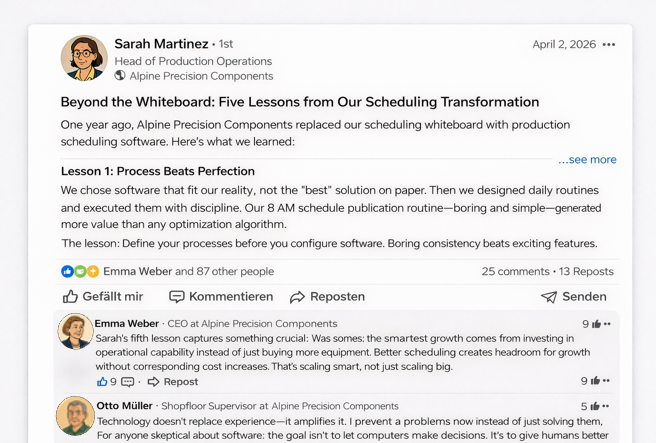
The final week of parallel operation and scheduling software implementation brought a critical shift. Instead of just comparing whiteboard to software, the team began documenting the exact routines they would follow once they went live.
Monday morning found Sarah, Stefan, Otto, Klaus, and Patrick in the conference room with a blank flip chart titled “Daily Scheduling Routines.”
“Before we go live,” Stefan said, “we need to define exactly what happens when. Not just what the software does, but what people do, in what sequence, with what authority.”
Sarah pulled up the process workflows they’d designed the previous week. “We have pieces—rush order process, communication protocols, authority rules. But we haven’t stitched them together into a daily routine.”
“Let’s build it hour by hour,” Emma suggested, having joined specifically for this discussion. “Start with Sarah’s morning. What’s the first thing she does when she arrives?”
Sarah thought about her current routine. “I review the whiteboard, check for overnight changes, and look at what should have been completed yesterday versus what actually did. And I check which new production orders need to get added to the schedule.”
“Now with software?” Stefan prompted.
“The automatic schedule generates at 6 AM,” Sarah said. “It will automatically include all new firm planned production orders based on the general priority rules that we defined. Other than what we assumed initially, we will keep the planned production orders out of the scheduling software. They are too vague, and we let them be fully controlled and managed by MRP and the planning worksheet.”
“I like the idea of keeping the schedule free from too vague production orders. This will help you to stay focused. Who is in charge of creating firm planned production orders, and when will we turn a planned order into a firm planned order?” asked Emma.
“I am in charge”, Klaus answered. “Firm planned production orders are created via MRP and the planning worksheet. We create firm planned production orders if one of the following is true: First, if we have concrete demand created by the general planning parameters on the item card. Examples are when we are below the critical inventory level for standard partners. Second, if we have a concrete customer demand from a released sales order.”
“Hmm”, Emma objected. “What happens if we get customer orders well in advance? We schedule ASAP. Will this cause us to load the schedule and hence the capacity too early?”
“No”, was Sarah’s immediate and confident reply. Remember the planning horizon discussion we had? The scheduling software will only pull in production orders that have a due date within the next four months.”
“Perfect. Then back to the process and the responsibilities. I understand that Klaus is responsible for creating new production orders via MRP. How often do you do this, and who is responsible for it when you are on leave?”
Klaus stood up, went to the flip chart, and wrote:
MRP routines impacting scheduling
- What: create firm planned production orders
- Who: Klaus; backup: Sarah
- When: Tuesday & Thursday afternoon
“Great”, Stefan concluded. “Now we know how new production orders will get created by whom, and when. They will be automatically pulled into the scheduling software every Wednesday and Friday and automatically scheduled in the respective morning runs according to the priority rules we agreed upon. What’s next, Sarah? How do your daily scheduling routines look like?”
“So, I arrive at 7 AM and review the new schedule. Check for red flags—like late orders and material issues. Review Otto’s overnight notes about any changes he made and any short-term capacity issues he is aware of, e.g., if an operator called sick that morning.”
“And then?” Emma asked.
“Then I make corresponding adjustments based on business priorities that the software doesn’t know about. Lock those changes. Generate a final schedule for the day by 8 AM so Otto and the supervisors have it when the first shift starts.”
Stefan was documenting this. “So: 6 AM automatic generation, 7-8 AM Sarah’s review and adjustments, 8 AM final schedule published. That’s your morning routine. Otto, what’s your routine?”
Otto considered this. “I arrive at 6:30 AM, walk the shop floor to see what was actually completed overnight, note any issues—machines acting up, quality problems, operators calling sick, whatever. By 8:00 AM, I review Sarah’s schedule and communicate the day’s work to my team on the shop floor.”
“And during the day?” Stefan asked.
“When things change—machine breaks, material arrives, operator is unwell—I update the schedule and lock my changes. Send Sarah a quick note explaining why. If the change is major, I call her instead of just leaving a note.”
Klaus jumped in. “When do I check for customer communication? We designed that workflow last week, but haven’t scheduled it.”
“9 AM daily,” Sarah suggested. “After I publish the final schedule, you will receive the schedule change report showing any jobs that slipped. You review it and reach out to affected customers proactively.”
Stefan captured all of this on the flip chart:
Daily Scheduling Routine:
- 6:00 AM: Automatic schedule generation
- 6:30 AM: Otto’s shop floor walk and notes, including ad-hoc capacity incidents
- 7:00 AM: Sarah reviews schedule, makes adjustments
- 7:45 AM: Sarah publishes final schedule for the day
- 8:00 AM: Otto communicates schedule to shop floor operators
- 9:00 AM: Klaus reviews schedule changes, communicates with customers
- During day: Otto makes further adjustments as needed, notifies Sarah
- 4:00 PM: Sarah reviews tomorrow’s schedule, flags concerns
- End of day: Production updates post to Business Central
“That’s it”, Emma nodded and looked at the flip chart. “We now have routines and rules to create new production orders, and we have a daily scheduling routine. I agree with what we said before: process beats software.”
Bääääm. – Otto smashed his hand to his forehead. Then he started to laugh. Before anyone from the team could say anything, he said, still giggling: “Holy moly. We have been so obsessed with drafting the perfect scheduling routine. And then we missed the most important thing.”
He took a break and seemed to enjoy looking at the puzzled faces of his colleagues. “You have no clue what I am talking about, right? Well, here you go. Klaus’ MRP magic will throw firm planned production orders into the scheduling software. Sarah will schedule them, and I will communicate the schedule to my guys.
We will work on the production orders and then are assumed to post output and consumption at the end of the day. Patrick, you are our BC hero. Can you please kindly show me how this posting works with firm planned productions?”

Patrick looked at Otto, then at Sarah. Sarah looked at Klaus, and Klaus at Stefan. Then they all started to laugh, before Emma asked: “Forgive me. I am the CEO. I am not into all the details. What did I miss that is funny?”
“Well,” Sarah started, still grinning. “You cannot post output and consumption to firm planned production orders. We just forgot to design the process step of releasing production orders. And honestly, this is an important step as it controls the workload for the shop floor.”
“How are you doing it today?” Stefan wanted to know.
Sarah answered: “We release a production order when we have all the required material on site. Because this then tells us that we are ready to start the work.”
“But,” Otto objected, “we discussed this before: this is not ideal. That way, sometimes new production orders hit the shop floor too early. Then orders pile up, my team gets stressed, and they try to do it all at once. Creating more confusion than progress – especially if I dare to take a few days off. I wish we would better control that step as well.”
“Go it,” Sarah confirmed. “What about the following? I know that I can release production orders with the scheduling software and that the software has a material availability indicator. What if I take ownership for releasing production orders if the material is onsite and if the scheduled start of the production order is within the next three days? This should help us to control the flow.”
“That is what I was hoping for,” Otto said. “Somebody is adding operational intelligence to my gut feel. And if you do it in the evening, the newly released production orders will become part of next day’s scheduling routine.”
Sarah stood up and changed the second last bullet:
- 4:00 PM: Sarah reviews tomorrow’s schedule, flags concerns, and releases production orders (acc. to rules defined)
“This is your operating rhythm,” Stefan said. “Every day, the same sequence. Automatic generation, human review, final adjustment, operational execution, proactive communication. Discipline around these routines is what makes the system work. Successful scheduling software implementation depends less on the technology itself and more on the disciplined operational routines that govern how people use it.
And if you face intra-day incidents such as machine breakdowns, you run a fast micro version of that process.”
Emma studied the timeline. “What about weekly routines? Monthly?”
Sarah hadn’t thought about longer cycles. “Good question. What should we do weekly?”
“Review the four-month horizon,” Stefan suggested. “Make sure orders are loading correctly as they enter the scheduling window. Check for any capacity hotspots two or three months out that need attention.”
“Review critical materials list,” Klaus added. “Make sure we’re flagging the right components as hard constraints based on supplier performance.”
“Review operator skill matrix,” Otto said. “Update certifications when people complete training. Flag where we need more cross-training based on scheduling conflicts we’re seeing.”
Stefan created a second flip chart for weekly routines, then a third for monthly routines (data quality review, process refinement, configuration tuning).
“These routines are your discipline,” Stefan emphasized. “The software enables the work, but discipline in following these routines ensures the work gets done consistently. Miss your 8 AM final schedule publication, and the shop floor starts without clear direction. Skip the weekly horizon review, and you’ll hit capacity problems you should have seen coming.”
“This is what Henning meant by pragmatic philosophy,” Sarah realized. “Not just configuring the software pragmatically but operating it pragmatically—with disciplined routines that make the practical approach actually work.”
Scheduling Software Implementation: The Final Preparations
Friday afternoon of the final parallel week brought the final readiness check. Stefan projected both the whiteboard photo and the software schedule side by side.
“This week, I observed Sarah to schedule with the software first. Then she went to the whiteboard as a kind of sanity check, ” Stefan reported. “This helped her to make legitimate judgment calls where Sarah’s business knowledge trumped the software’s logic.”
“That’s remarkable progress,” Emma said.
“It is,” Stefan confirmed. “More importantly, Sarah’s confidence has grown. Monday morning, she second-guessed every software decision. Friday afternoon, she’s trusting the software for the computational heavy lifting and applying her judgment only where it truly adds value.”
Sarah nodded. “The first few days, I kept thinking ‘the whiteboard would have done this differently.’ By Thursday, I was thinking, ‘the software handles this better than I did manually.’ The shift happened faster than I expected.”
“Ready to go live on Monday?” Emma asked.
Sarah took a deep breath. “Yes. I mean, I’m terrified. But yes, I’m ready.”
“What about the team?” Emma looked at Otto.
“The supervisors have been practicing with the software all week,” Otto replied. “They can read schedules, understand the color coding, and know how to report issues. We’re ready.”
Emma stood. “Then we will go live Monday morning. Stefan, what do we need to do this weekend?”
“Nothing technical,” Stefan replied. “The software is configured and tested. But I’d suggest a symbolic gesture. Take down the whiteboard. Put up a large screen showing the software with the machine workload scheduled for the next 7 days. This won’t only make the current schedule itself visible but also make it visible that we’ve transitioned.”
The Symbolic Moment
Saturday morning, Emma, Sarah, Patrick, and a facilities technician gathered in the production scheduling area. The whiteboard that had dominated the wall for over a decade—covered with magnetic strips, color-coded markers, and years of scheduling decisions—stood ready for removal.
“Should we take a picture?” Patrick suggested.
“Already did,” Sarah said, holding up her phone. “Took one last week. The whiteboard in its final glory, complete with all the chaos and complexity we’ve been managing.”
The facilities technician carefully removed the whiteboard from the wall, revealing clean space behind it. In its place, they mounted a large 55-inch display screen that Patrick had configured to show the scheduling software’s main Gantt chart view.
When Patrick powered it on, the screen lit up with the coming week’s schedule—colored bars flowing across machines and operators, green jobs indicating on-time work, the familiar interface they’d been practicing with for the past weeks.
“It looks so… clean,” Sarah observed. “The whiteboard was covered with notes, corrections, and emergency changes. This is just the schedule.”
“Because the notes and corrections happen in the system now,” Patrick explained. “Digital rather than physical. But they’re still there—in the change log, the communication notes, the manual override flags.”
Emma studied the screen. “Is this visible from the shop floor?”
“That’s the point,” Patrick confirmed. “Anyone walking by can see the current schedule. No more walking up to Sarah’s office to check the whiteboard. It’s right here, always current, always accessible.”
Sarah felt an unexpected wave of emotion. The whiteboard had been her tool, her domain, her responsibility for three years. Seeing it gone felt like losing a part of her professional identity.
“Second thoughts?” Emma asked, noticing her expression.
“No,” Sarah said. “Just… acknowledging an era ending. That whiteboard represented a way of working. Taking it down means we’re committed to the new way. No going back.”
“There’s always going back,” Emma said gently. “We keep the whiteboard in storage. If the software fails catastrophically, we can return to the old method. But I don’t think we will. I think we’re moving forward.”
Monday Morning—The Moment of Truth
Monday morning, Sarah arrived at 6:45 AM—fifteen minutes earlier than her new routine specified, because she was too anxious to wait. The large display screen showed that the overnight schedule generation had completed successfully. Green bars dominated the view, with a handful of yellow and two red conflicts visible.
She sat at her computer and began her review routine. The two red orders were material-related—critical components hadn’t been confirmed in stock yet. She sent Klaus a note to verify material status. The yellow orders showed tight but achievable timing. She approved them without changes.
Three jobs needed manual adjustments, and she moved them to preferred machines based on tooling availability that the software couldn’t know about. She locked those changes and regenerated. The schedule updated in seconds.
At 7:30 AM, Otto arrived and immediately checked the large screen. “Morning, Sarah. How’s it look?”
“Solid,” Sarah replied. “Two material issues Klaus is checking. Everything else is good to go. The operator assignments are in the system—check machine assignments and let me know if anything looks wrong.”
Otto reviewed the schedule on his tablet—one of the new tools they’d provided supervisors to access the schedule anywhere on the shop floor. “Looks right. Schmidt on Mazak #2 and #5, Müller on #7, Hoffmann on #3 and #4 for the agricultural work. Weber on #1 for the bearing housings. This matches what I would have assigned manually.”
At 8:00 AM, Sarah published the final schedule. A notification went to all supervisors’ tablets: “Today’s schedule published.” The large display screen updated with a green banner: “Schedule Final—Updated 8:00 AM”
Klaus arrived at 8:15 AM and pulled up his schedule change report. “Three customer notifications needed. All minor—jobs moving one day later due to material timing. I’ll make those calls this morning.”
And just like that, the first morning running on software rather than on whiteboard was complete. No drama, no crisis, just systematic execution of the routines they’d designed.
The first challenge
Of course, it couldn’t stay calm for long. At 9:47 AM, Sarah’s phone rang. Klaus, sounding stressed.
“Brenner Industries needs an expedited order. Twenty bearing housings must ship on Thursday. And before you ask, yes, this is critical—their production line is down, and they need these parts to restart.”
“Got it,” Sarah said. “Give me five minutes.”
She opened the rush order workflow they’d designed. Created the production order directly from the sales order in Business Central, flagged it as a rush priority, and set Thursday delivery. Generated a new schedule.
The software placed the rush order across Mazak #2 and #5, starting tomorrow. But it pushed three other jobs later—one of them now showing red, finishing Friday instead of its Thursday due date.
Sarah checked the customer. Kemper. She pulled up her customer notes—Kemper had some flexibility usually. She called their production planner.
“Hi, this is Sarah from Alpine. We have your order scheduled to complete Thursday, but we’ve got a critical rush situation. Can you accept delivery on Friday instead?”
Three minutes of conversation later, she had approval. She accepted the schedule change and locked it.
At 9:52 AM, five minutes after Klaus’s call, she called him back. “Rush order is scheduled. Starts tomorrow morning on Mazak #2, finishes Wednesday, ships Thursday. I had to push Kemper’s order to Friday, but got their approval. You can confirm the rush order delivery with Brenner.”
Klaus sounded stunned. “You found capacity and got customer approval in five minutes?”
“The software showed me the impacts immediately,” Sarah explained. “I just had to make two decisions—which job to delay and whether the customer would accept it. Everything else was calculation.”

As she hung up, Otto appeared at her desk. “Just saw the schedule update. Moving the Brenner rush order to Mazak #2 tomorrow means we need to bump today’s ending job. Schmidt has about an hour of work left. Do you want him to finish it today on overtime, or should we shift it to tomorrow morning?”
This was the kind of decision Sarah had made a hundred times on the whiteboard, usually with incomplete information and lots of guessing about cascade effects.
Now she pulled up the detailed schedule. “If Schmidt finishes today on overtime, tomorrow’s setup for the Brenner job is straightforward—thirty minutes. If we defer to tomorrow morning, the setup becomes more complex because we’re switching from a different job type—probably forty-five minutes, and we might miss the delivery window.”
“So, overtime tonight is worth it?” Otto asked.
“Yes. Approve one hour of overtime for Schmidt. Better to invest an hour tonight than risk the rush order timing tomorrow.”
Otto nodded and headed back to the shop floor. Sarah marked the decision in the schedule notes so there was a record of why they’d approved the overtime.
Then, at 10:23 AM, Patrick appeared. “Procurement just notified me that the steel shipment for this week’s agricultural components is delayed two days. It was due tomorrow, now arriving on Thursday.”
This was exactly the kind of disruption that used to send Sarah into a tailspin on the whiteboard—manually tracking which jobs needed that material, trying to remember what could be moved, hoping she wasn’t creating downstream conflicts.
Now she opened the material conflict view in the software. It showed four production orders dependent on that steel shipment, all currently scheduled for Tuesday and Wednesday. She clicked “reschedule with material constraint” and let the software recalculate.
Three of the four jobs shifted to Thursday and Friday—still within their delivery windows. One job showed red—would finish Monday next week instead of Friday this week.
Sarah checked the customer: Agrar-Tech. Important but usually flexible. She called them.
“Hi, this is Sarah from Alpine. We’ve had a material delay that affects your order. Can you accept delivery on Monday instead of Friday?”
The conversation took four minutes. Agrar-Tech could accept Monday if Sarah confirmed by the end of the day today. She confirmed, accepted the schedule update, and locked it.
By 10:35 AM—twelve minutes after Patrick’s notification—she’d replanned around the material delay, verified customer acceptance, and updated the schedule. Every affected supervisor received automatic notifications on their tablets showing which jobs had moved and why.
Sarah sat back and took a breath. In the space of forty-eight minutes, they’d handled three significant disruptions—a rush order, an overtime decision, and a material delay. The kind of morning that used to consume at least three hours of frantic whiteboard adjustments and phone calls.
She’d handled it in under an hour, with complete visibility into impacts, documented decisions, and automatic communication to affected parties. This was the moment scheduling software implementation success became real—not when they configured features, but when those features handled actual manufacturing chaos better than the old whiteboard ever could.
Otto’s Evolution
Wednesday afternoon, Emma called a quick check-in meeting to assess the first three days of live operation.
“Biggest surprise?” Emma asked, looking around the table.
“Otto,” Klaus said without hesitation.
Otto looked up, surprised. “What about me?”
“You were the most skeptical about the software,” Klaus explained. “But you’ve become its biggest advocate. Yesterday I heard you explain to Weber why the software’s schedule was better than what he thought he should do.”
Otto shrugged. “Software’s not as dumb as I thought.”
“Tell us more,” Emma encouraged.
Otto thought about how to explain. “With the whiteboard, I was always reacting. Something would go wrong—machine breaks, material doesn’t show up, whatever—and I’d scramble to fix it. I was good at scrambling, but it was still scrambling.”
He pulled up the schedule on his tablet. “Now I can see three days ahead. This shows me, e.g. that on Friday afternoon, two jobs need Schmidt at the same time. On the whiteboard, I wouldn’t know about that until Friday afternoon when both jobs were supposed to start. Now I know it on Wednesday. So, I can either go for the option that Schmidt processes the tasks sequentially, as suggested by the software based on the defined priorities. Alternatively, I can cross-train Weber to handle one of those jobs. Hence I’m deciding, not scrambling.”
“The software doesn’t replace your judgment,” Sarah observed. “It gives you time to apply your judgment proactively instead of reactively.”
“Exactly,” Otto confirmed. “And another thing—when I make changes, everyone knows about them immediately. Yesterday I moved a job from Mazak #3 to #4 because #3 was making noise. The moment I locked that change, Weber got a notification on his tablet that his job tomorrow had moved to a different machine. He had time to get the tooling ready. On the whiteboard, he wouldn’t have known until he showed up tomorrow morning.”
“So, the software is a communication amplifier,” Patrick suggested.
“That’s a good way to put it,” Otto agreed. “It amplifies my knowledge forward in time—I see problems before they hit. And it amplifies my decisions outward to the team—everyone knows what’s changing and why.”
Emma smiled. “Three months ago, if I’d suggested replacing the whiteboard with software, what would you have said?”
Otto laughed. “I’d have said you were wasting money on technology that can’t match human experience.”
“And now?”
“Now I’d say the technology doesn’t match human experience—it enhances it. Makes my experience more valuable because I can apply it to preventing problems instead of just solving them.”
The Friday Celebration
Friday at 4 PM, the team gathered in the production area near the large display screen showing the week’s completed schedule. Emma had arranged for drinks and snacks, and she’d invited the entire shop floor team—operators, supervisors, and assembly workers—to join them.
“We made it through our first week,” Emma announced. “Sarah, walk us through the numbers.”
Sarah pulled up the week’s statistics on the display screen:
- 68 production orders completed (matching their target throughput)
- 76% on-time delivery (up from typical 72%)
- 18 schedule changes handled (down from typical 35-40)
- Zero emergency overtime (down from typical 15-20 hours/week)
- 3 major disruptions managed smoothly (rush order, material delay, machine issue)
“Those numbers tell part of the story,” Sarah said. “But the real story is how we handled this week. Monday morning’s triple crisis would have consumed half my day on the whiteboard. With the software and our routines, we handled it in under an hour.”
“What about mistakes?” Otto asked. “Nothing goes perfectly.”
“We had one mistake,” Sarah admitted. “Tuesday afternoon, I approved a schedule change without checking downstream impacts. It pushed out one production order past its due date and hence created a conflict Wednesday morning that we had to fix reactively. I should have regenerated the full schedule instead of just making a manual change.”
“But we caught it and fixed it,” Otto added. “And Sarah documented what went wrong so we can learn from it.”
“That’s the point,” Emma said. “We’re not expecting perfection. We’re expecting continuous improvement. Make mistakes, learn from them, adjust our processes.”
At 4:15 PM, the door opened, and Miguel walked in, carrying a wrapped package. He made his way through the crowd to Sarah.
“I’m told you accomplished something important this week,” Miguel said with a smile.
“We did,” Sarah confirmed. “First week without the whiteboard. Running entirely on the new system.”
“Then this is appropriate,” Miguel said, handing her the package.
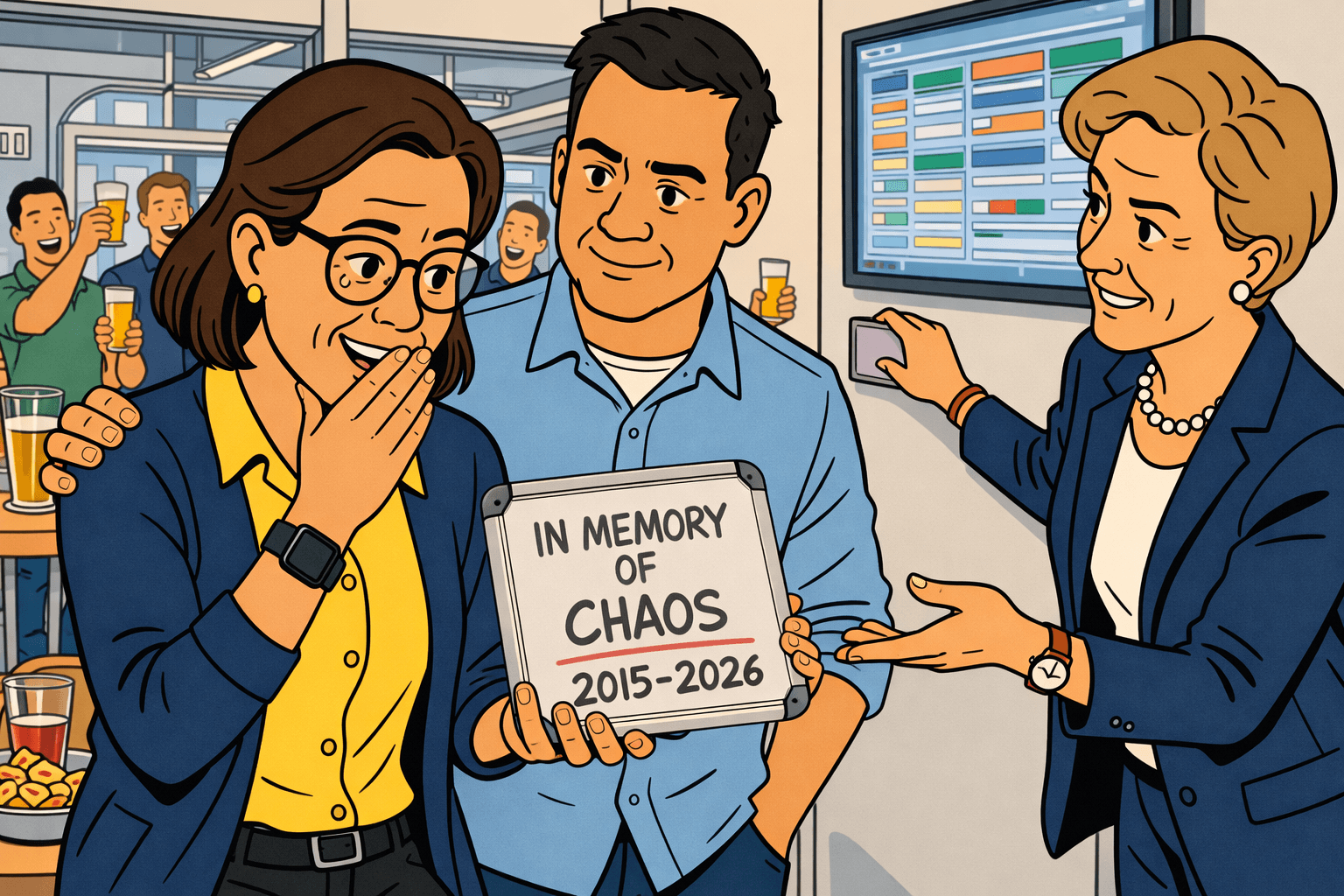
Sarah unwrapped it to reveal a small, framed whiteboard—maybe 20 cm by 30 cm—with a brass nameplate engraved “In Memory of Chaos, 2015-2026.”
The room erupted in laughter. Sarah found herself laughing too, even as she felt unexpectedly emotional.
“The whiteboard era is over,” Miguel announced. “Long live the software era.”
Emma took the miniature whiteboard and hung it on the wall next to the large display screen. “Perfect. A memorial to how we used to work, right next to the tool that shows how we work now.”
The team raised their glasses in a toast. “To process over software,” Klaus said.
“To pragmatic philosophy,” Sarah added.
“To prevent problems instead of just solving them,” Otto contributed.
As the celebration continued, Henning appeared on the large screen via video call. Someone had set up the connection so he could join remotely.
“Congratulations on a successful first week,” Henning said, his voice carrying across the production floor. “You’ve accomplished something significant. But I want to offer one observation as you celebrate.”
The room quieted, sensing something important was coming.
“The real work starts now,” Henning continued. “You’ve built a system—software configuration, process routines, communication protocols. You’ve proven it works for one week. Now comes the hard part: discipline.”
He let that word hang in the air.
“Discipline to run the 6 AM automatic generation every single morning, even when you’re tempted to skip it. Discipline to do Sarah’s 7 AM review every day, even when she’s busy or on vacation. Discipline to publish the final schedule at 8 AM sharp so the shop floor has clarity. Discipline to follow your communication protocols, update your skill matrix, review your critical materials list, and conduct your weekly horizon checks.”
“This first week, you had adrenaline and novelty driving you,” Henning explained. “The excitement of trying something new. Next week, it becomes routine. In a month, it becomes boring. In six months, you might be tempted to cut corners—skip a routine, make a quick manual change without documentation, bypass a protocol because it seems unnecessary in that moment.”
He paused, making eye contact through the camera. “That’s when you fail. Not this week when everyone is excited and focused. But in six months, when discipline flags and someone says ‘we don’t need to follow the routine this time, we know what we’re doing.'”
“The routines you’ve designed, the daily scheduling cycle, the weekly reviews, the monthly process checks, those aren’t bureaucracy. They’re your competitive advantage. They’re what separates reactive chaos from proactive excellence. But they only work if you maintain discipline in executing them.”
Emma nodded slowly. “You’re saying the challenge shifts from building the system to maintaining the discipline to operate the system.”
“Exactly,” Henning confirmed. “Building is exciting. Maintaining it is boring. But manufacturing success comes from boring discipline on the scheduling and execution side. You’ve innovated this week. Now comes the boring part—doing it the same way, every day, for months and years.”
Sarah felt the weight of this responsibility. She’d been so focused on building the routines, configuring the software, and designing the processes. She hadn’t thought deeply about the daily discipline required to sustain them.
“How do we maintain that discipline?” she asked Henning.
“By making it non-negotiable,” Henning replied. “The 8 AM final schedule publication isn’t something you do when convenient. It’s something you do every day at 8 AM, period. Sarah’s on vacation? Patrick covers it. Sarah and Patrick both unavailable? Emma steps in. The routine happens regardless of who executes it.”
“And by measuring adherence,” he continued. “Track how often you actually execute the routines you’ve designed. If you’re skipping the weekly horizon review, that’s a warning sign. If manual overrides are increasing instead of decreasing, that’s a warning sign. If you’re consistently missing the 8 AM publication time, that’s a warning sign. Measure the process discipline itself, not just the outcomes.”
“That’s wise,” Emma said. “Sarah, add process adherence metrics to your weekly dashboard. I want to know if we’re following our designed routines consistently.”
The celebration continued, but with a more sober undertone. They’d accomplished something significant this week. But Henning’s reminder had grounded them—the first week was just the beginning. The real test was whether they could maintain this level of discipline week after week, month after month.
The Week’s End
As the celebration wound down and people drifted back to their normal Friday afternoon routines, Sarah stood with Miguel, looking at the large display screen showing the week’s schedule in green—complete, on time, successful.
“That miniature whiteboard was perfect,” Sarah said. “Where did you get the idea?”
“Tom, actually,” Miguel replied. “He said you were retiring the whiteboard, and he thought you should have something to remember it by. The ‘In Memory of Chaos’ was my addition.”
Sarah laughed. “It’s surprisingly emotional. I didn’t expect to feel sentimental about a whiteboard.”
“It represented a few years of your professional life,” Miguel observed. “And it represents a way of working—your way, individual, personal. Now you’re working systematically, with processes and routines that others can follow. That’s a big change.”
“It is,” Sarah agreed. “But also necessary. The whiteboard worked when we were smaller. It couldn’t scale. This can.”
“Speaking of scaling,” Miguel said, “you look less stressed than you have in months.”
Sarah thought about this. “I am less stressed. Not because the work is easier—this week was full of disruptions and problems. But I have visibility now. I can see problems coming and address them proactively. I’m not constantly reactive, waiting for the next crisis to hit.”
“That’s what Henning meant about preventing problems instead of solving them,” Miguel said.
“Right. And it’s what Otto discovered too—the software gives him time to think, to plan, to prevent. It doesn’t remove the problems, but it changes when and how we deal with them.”
They stood quietly for a moment, watching the screen show the week’s completed work flowing across machines and operators in orderly, colored bars.
“What was the biggest lesson this week?” Miguel asked.
Sarah considered carefully. “That the software wasn’t the transformation. The routines were. We could have bought the most sophisticated scheduling algorithm in the world, but without the discipline to follow systematic routines, it would have failed. The software is just the tool that forces us to design and follow those routines.”
“Process over software,” Miguel said, echoing the toast.
“Process over software,” Sarah confirmed. “And now comes the hard part—maintaining the discipline to follow those processes every single day.”
She looked at the memorial whiteboard hanging next to the display screen. In memory of chaos. That’s what they’d left behind—not just a physical whiteboard, but the reactive chaos that whiteboard represented. Individual heroics, tribal knowledge, constant firefighting.
What they’d gained was systematic operation. Clear routines, documented processes, proactive planning. It was less exciting than heroics, but far more sustainable.
“Ready for week two?” Miguel asked.
“Ready for week two through week two hundred,” Sarah replied. “This is our new normal. Not perfect, but disciplined. Not exciting, but sustainable. Not heroic, but systematic.”
And that, she was learning, was exactly what excellence looked like in manufacturing—not dramatic rescues, but boring discipline applied consistently over time.
The whiteboard era was over. The systematic era had begun. And the real work—the boring, disciplined, sustainable work—was only just starting.