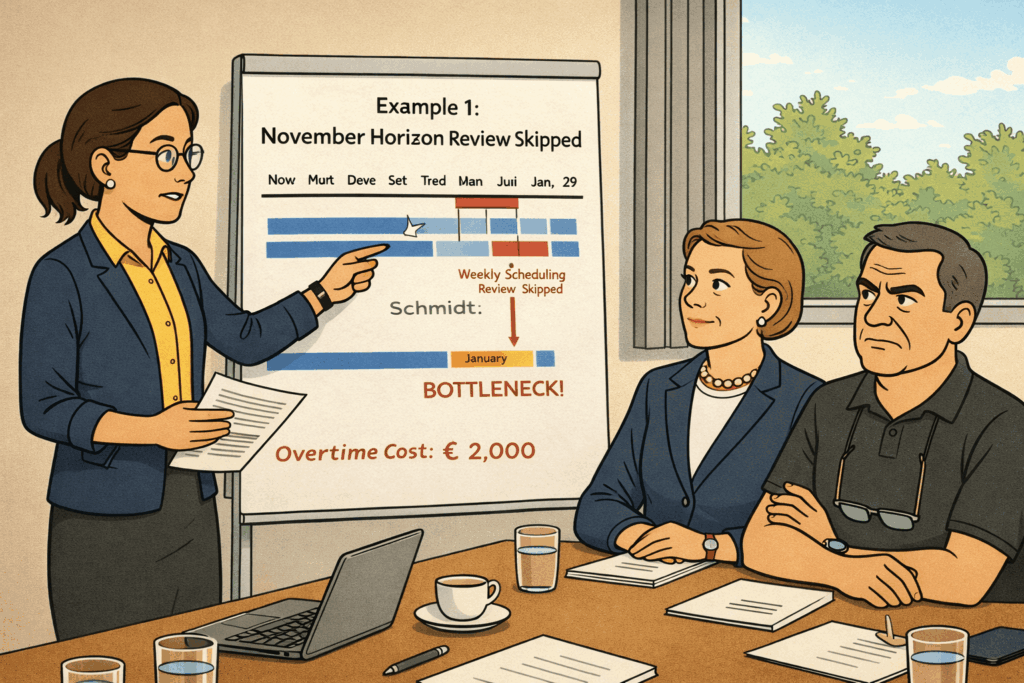
Six weeks later. Sarah sat at her kitchen table on a Saturday morning, laptop open. The regional manufacturing conference presentation from last month had generated dozens of follow-up questions, all variations of: “Where do we start?”
She opened LinkedIn and began typing.
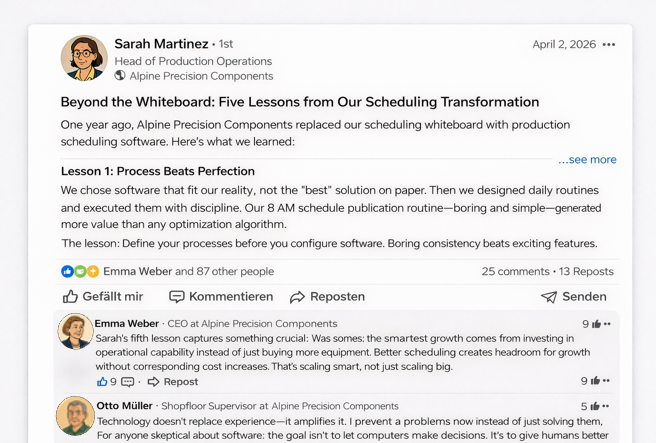
Beyond the Whiteboard: Five Lessons from Our Scheduling Transformation
One year ago, Alpine Precision Components replaced our scheduling whiteboard with production scheduling software. Here’s what we learned:
Lesson 1: Process Beats Perfection
We chose software that fit our reality, not the “best” solution on paper. Then we designed daily routines and executed them with discipline. Our 8 AM schedule publication routine—boring and simple—generated more value than any optimization algorithm.
The lesson: Define your processes before you configure software. Boring consistency beats exciting features.
Lesson 2: Data Quality is Foundational
The hardest work wasn’t software configuration. It was master data cleanup—routings with non-existent machines, setup times showing zero when reality was 45 minutes, work centers showing 24/7 availability for one-shift operations.
We categorized issues: “breaks scheduling” vs. “makes scheduling inaccurate” vs. “makes scheduling suboptimal.” We fixed the first completely, addressed the second for high-volume products, and accepted the third as continuous improvement.
The lesson: You can’t schedule what you can’t measure accurately. Garbage in, garbage out.
Lesson 3: People Are the Key
Our shop floor manager Otto was skeptical about “trusting a computer over thirty years of experience.” Three months in, he became our strongest advocate—not because the software was smarter, but because it amplified his expertise. He could see conflicts three days ahead instead of three hours ahead.
The lesson: Technology enables people; engaged users determine success. Design processes that complement human judgment rather than replace it.
Lesson 4: Integration Matters
We chose software that integrated natively with Business Central rather than a standalone APS system. We avoided months of integration development and ongoing interface maintenance.
The lesson: Scheduling works best as part of an integrated business system. Integration complexity compounds over time. Choose architecture that minimizes ongoing burden.
Lesson 5: Start with Understanding
We thought scheduling meant “optimal sequences that minimize costs.” We learned that for high-mix, low-volume job shops, scheduling means “feasible sequences that focus on throughput and adapt quickly when reality differs from plans.”
That understanding changed everything—what software we chose, how we configured it, what processes we designed.
The lesson: Know what scheduling really means for YOUR business before choosing tools.
The Results (One Year)
- On-time delivery: 72% → 94%
- Overtime costs: -35%
- Throughput: +19%
- EBITDA: negative to positive
- Customer complaints: -86%
But the real transformation was cultural—from reactive firefighting to proactive planning, from individual heroics to systematic processes, from chaos to discipline.
Final Thought
We saw modest gains at three months, compelling results at twelve months. Transformation takes time. The boring work of executing routines consistently is what sustains results.
The whiteboard era is over. The systematic era continues.
Sarah clicked “Post.”
The Response
Within hours, comments appeared:
Emma Weber, CEO, Alpine Precision Components: “Sarah’s fifth lesson captures something crucial: sometimes the smartest growth comes from investing in operational capability instead of just buying more equipment. Better scheduling creates headroom for growth without corresponding cost increases. That’s scaling smart, not just scaling big.”
Klaus Brenner, Plant Manager, Alpine: “The customer impact has been profound. When we hit delivery dates 94% of the time, customers notice. We’ve won business specifically because of delivery reliability. Operational excellence is a competitive advantage.”
Otto Müller, Shopfloor Supervisor, Alpine: “Technology doesn’t replace experience—it amplifies it. I prevent problems now instead of just solving them. For anyone skeptical about software: the goal isn’t to let computers make decisions. It’s to give humans better information to make better decisions.”
Henning A. Karlsen, Manufacturing Consultant: “This post should be required reading for every company evaluating scheduling software. The focus on process over features, on integration architecture, on organizational readiness—these determine success, but vendors rarely emphasize them. Brilliant summary of hard-earned lessons from someone who actually did the work.”
A production manager from Munich: “Month two of our implementation. Your categorization of data quality issues is exactly the framework we needed.”
A CEO from a similar manufacturer: “Your lesson about starting with understanding just reframed our entire evaluation. We were asking ‘what’s the best scheduling software?’ when we should ask ‘what does good scheduling look like for OUR business?’ Different question, different answer.”
By evening, the post had 3,000 views, twenty-five comments, and thirteen reposts.
Sarah closed her laptop and smiled. Production scheduling had become sexy on social media.
Who knew?
Authors’ Note:
This story is based on real challenges faced by small-to-medium manufacturing businesses and real solutions that work in practice. The characters are fictional, but their struggles, decisions, and eventual success reflect patterns observed across dozens of actual implementations.
Key takeaways for readers:
- Process design matters more than software features
- Data quality is foundational to scheduling success
- Organizational change is harder than technical implementation
- Discipline in execution sustains results
- Transformation takes time but compounds with consistency
For manufacturing leaders facing similar challenges: you’re not alone, these problems are solvable, and the investment in systematic operation is worth making.
The tools change. The principles endure.